HISTORY · 2026-08-12
Mochi and Its Cousins: Rice Cakes Across Asia
By Dduk Curator
From Japanese kagami mochi to Chinese nian gao and Filipino tikoy — how sticky rice traveled Asia's rituals.
TL;DR
From Japanese kagami mochi to Chinese nian gao and Filipino tikoy — how sticky rice traveled Asia's rituals.
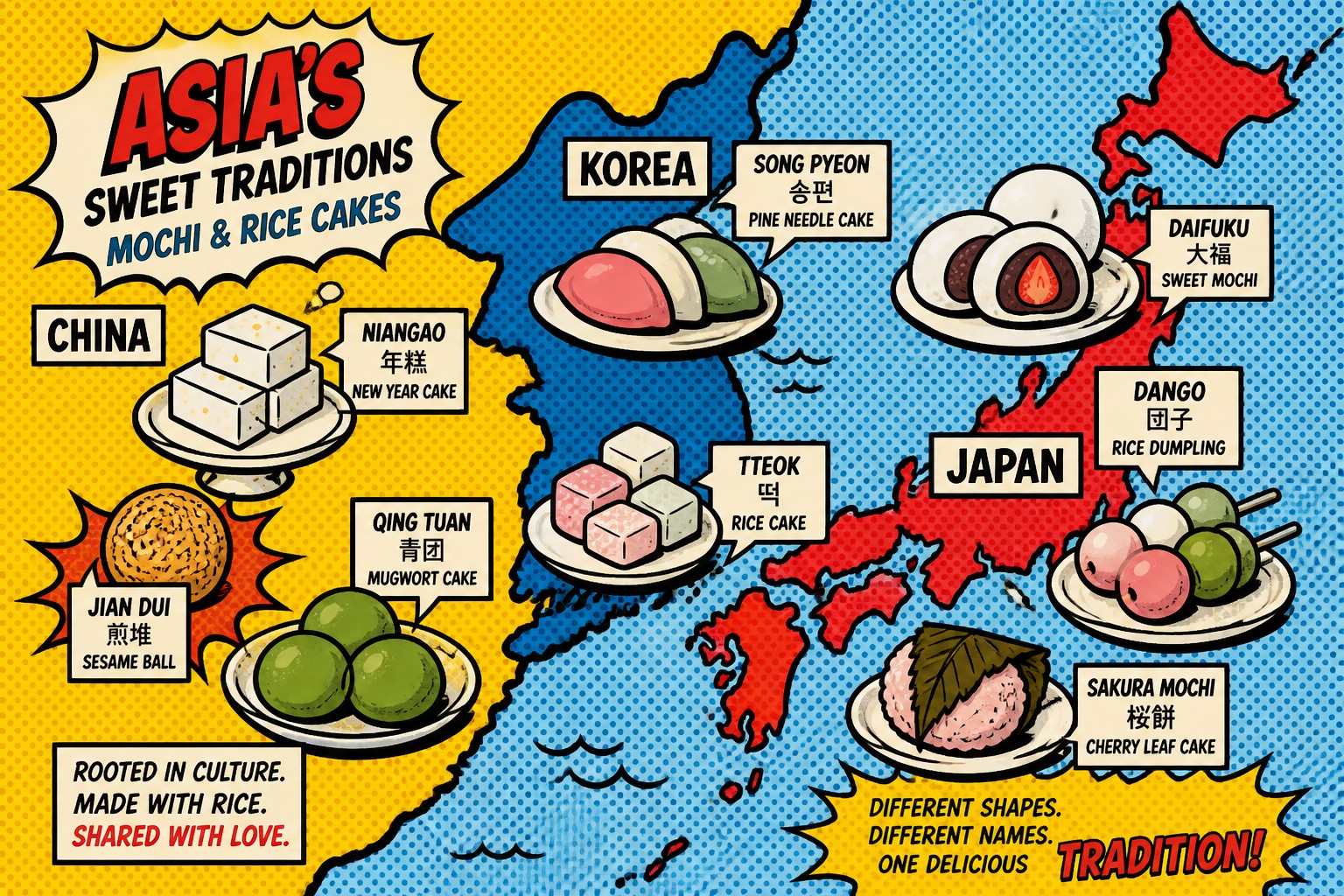
Mochi's deepest ritual is Japanese Oshogatsu kagami mochi — stacked rounds reflecting the new year — pounded communally at mochitsuki. Chinese nian gao uses glutinous rice flour steamed dense and sweetened dark with brown sugar for Lunar New Year, sliced and pan-fried as 'wealth cakes' that puff and crisp; Filipino tikoy is its direct descendent via Chinese migration, often fried with egg.
Korean dduk sits within that family yet distinct: siru-steamed, bean-topped, pine-scented, and tied to Korean lunar rites rather than Japanese or Chinese templates. The shared physics — amylopectin gelatinization — traveled via rice itself; rituals localized the toppings and shapes.
Southeast Asian parallels enrich the picture: Thai khanom tom and Indonesian klepon are filled sticky-rice balls akin to small songpyeon, rolled in coconut rather than soybean powder; Vietnamese banh chung is a savory rectangle of sticky rice and pork that, like tteokguk, marks Tết through rice as prosperity. Each uses stickiness as a metaphor for binding community.
Technique comparison reveals culture: mochi emphasizes pounding temperature and speed for stretch; dduk emphasizes siru layering and cutting for variety; nian gao emphasizes molding and density for shelf life. The same starch, different values made edible.
Tasting respectfully means buying from makers of each tradition, not substituting one for all. Eat dduk as dduk, mochi as mochi, nian gao as nian gao — and note how sweetness, bean, and oil shift to fit local palates while rice remains the constant language.
Across the Kimchee Network
More from the Kimchee Network